|
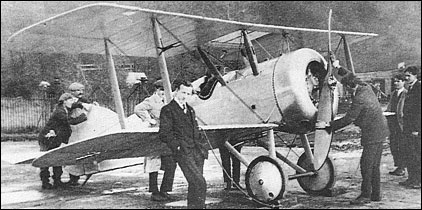
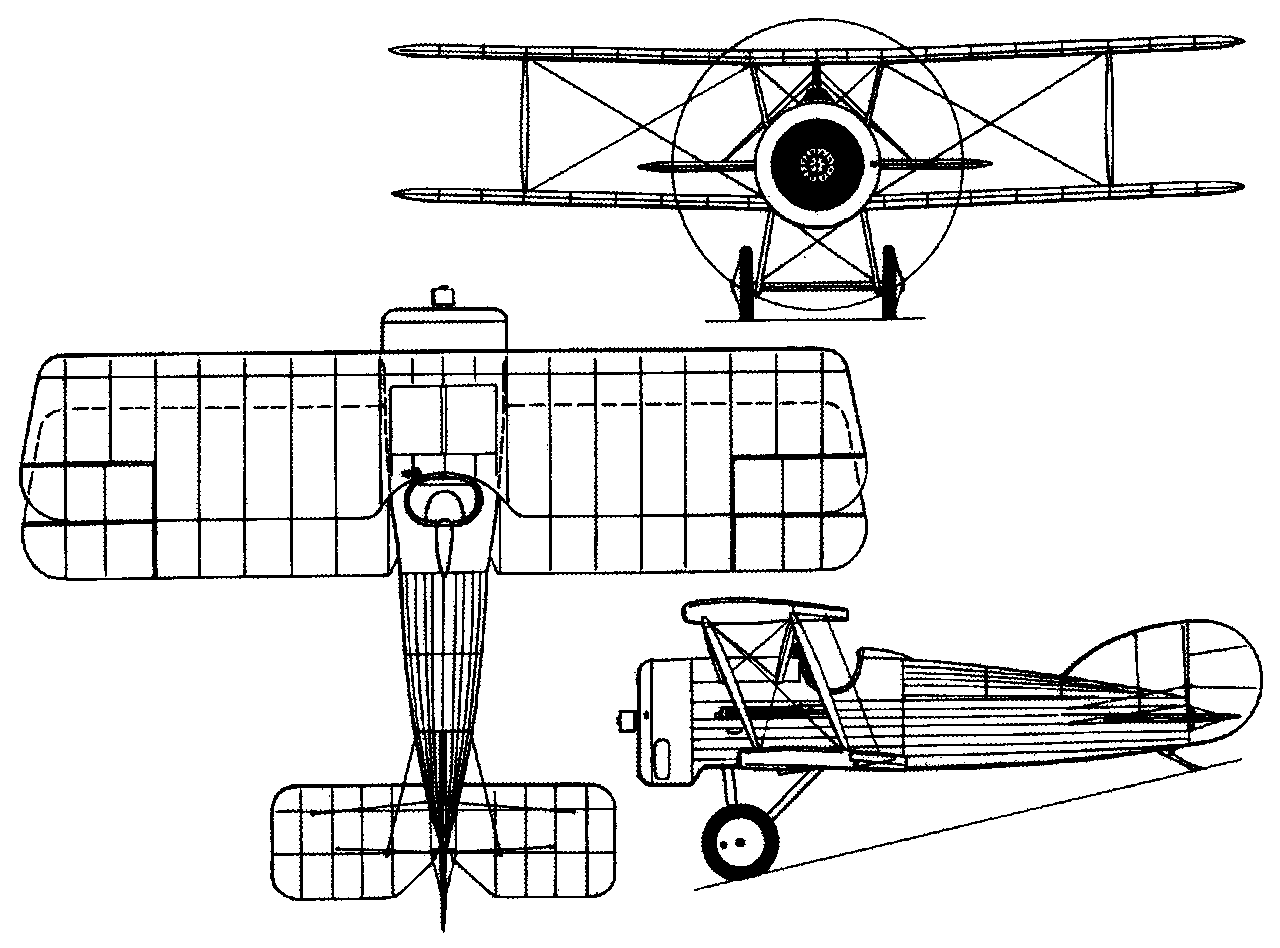
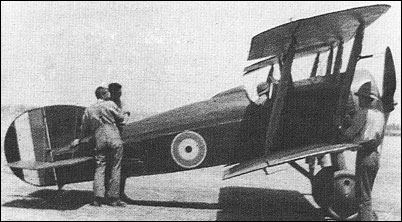
| Designed in 1916 by G H Challenger and flown for the first time in August of that year, the F.B.19 was a single-bay unstaggered equi-span biplane with a single 7.7mm Vickers gun mounted on the port side of the fuselage and a 100hp Gnome Monosoupape engine. Ordered by the War Office for the RFC, the series version was powered by either the Gnome or the 110hp Le Rhone. Some 50 F.B.19s were built, and, late in 1916, a batch of six was sent to France where, after operational evaluation, the fighter was deemed un-suited for the fighting conditions then evolving. At this time, some of the F.B.19s were delivered to the Russian government following demonstrations in Petrograd, Moscow, Kiev and Tiflis, but several were still in their crates on the docks at Archangel at the commencement of the Bolshevik revolution. These aircraft were destroyed by the Royal Navy, but a few others assembled prior to the Navy's action were flown in Bolshevik service. A modified version, the F.B.19 Mk II, was developed with wing stagger and either the Le Rhone or Clerget 110hp rotary. Only 12 Mk IIs were built and several of these were included in a batch of 12 F.B.19s sent to the Middle Eastern theatres of war. These were flown in Palestine and Macedonia from June 1917, but no squadron used the type exclusively and it was not well liked.
 | A three-view drawing of F.B.19 Mk II (1280 x 948) |
| MODEL | F.B.19 |
| ENGINE | 1 x Gnome Monosoupape, 75kW |
| WEIGHTS |
| Take-off weight | 670 kg | 1477 lb |
| Empty weight | 405 kg | 893 lb |
| DIMENSIONS |
| Wingspan | 7.31 m | 24 ft 0 in |
| Length | 5.54 m | 18 ft 2 in |
| Height | 2.51 m | 8 ft 3 in |
| Wing area | 19.97 m2 | 214.96 sq ft |
| PERFORMANCE |
| Max. speed | 158 km/h | 98 mph |
| Ceiling | 5180 m | 17000 ft |
| William R. Leon, e-mail, 22.08.2026 22:56 Sources I have state that only 62-65 machines were built. The aircraft was not liked at all by the Royal Flying Corps, and only 25 were retained by the RFC. They fought briefly on the Western Front, before being sent to secondary and less hazardous fronts like the Middle East, Palestine, or Mesopotamia. Possibly a small handful were kept in Great Britain for home defense. All British aircraft were withdrawn by the close of 1917 for use as trainers or squadron hacks. The aircraft was viewed a little more favorably by the Russians. But since its introduction was just months before the Russian revolution, Russian examples probably saw a service life that ended before 1917 was over as well. reply | | Nikolai Koptiug, e-mail, 11.05.2023 17:21 According to the archive documents, a single MkI was sent on 2 August 1916 in two crates to Russia (SS Santaren) as a demonstration. According to sanction №10643 of the British Government on 24 /9 /16 an order №17 for 50 VICKERS-SCOUT Airplanes with spares for the Russian Air Corps was placed. (44000£). The order had been completed in 1917. According to the "List of aircraft available at the Central Aviation Depot in Moscow" on 20.09.17, there still were 43 Vickers (without engines). It is known that at least 4 aircraft were used at Russian W and SW fronts in the autumn of 1917. reply | | Billy R Leon, e-mail, 21.12.2021 09:55 I have run into some controversy regarding this aircraft. Some and I should say most sources describe this aircraft as single-seat biplane, while others indicate that the aircraft was a pusher design. Perhaps they are confusing it with the "Gunbus". But any clarity would be most appreciated. reply | | Sven, 29.11.2016 01:19 Used by Nos 111 squadron in Palestine and 17 and 47 in Macedonia.possibly no 11 on the western front. Manoeuvrability appears to be its weakness. They seem to lose the Hun as he starts manoeuvring . Major Geneeral W S Branker. reply | |
| | Frank, e-mail, 24.11.2016 04:39 I am trying to put together fabrication drawings for the FB.19 Mk 1 as used in Russia just before and after the Revolution of 1917. Anyone know of existing drawings? reply | | beifang, 21.06.2011 04:47 but no squadron used the type exclusively and it was not well liked. reply |
|
Do you have any comments?
|
| 
COMPANY
PROFILE
All the World's Rotorcraft
|