|
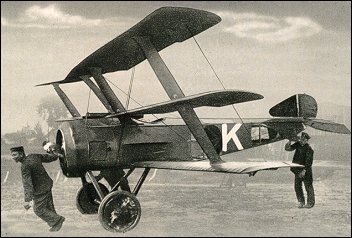
| Said to have been the progenitor of the Fokker Dr.I triplane - and therefore various other less successful German triplanes - the Triplane single-seat fighter was nicknamed 'Tripehound'. First flown in prototype form on 28 May 1916, it had been evolved as a faster-climbing derivative of the Pup, with even better manoeuvrability and improved vision for the pilot. Wing span remained the same as for the Pup, but each wing was of much narrower chord and had an aileron fitted.
Initial production Triplanes, with 82kW Clerget rotary engines, had been ordered for the RFC. In the event they were delivered to the RNAS, as were later examples with 97kW Clerget engines fitted. The top exponent of the Triplane was Raymond Collishaw, who commanded 'B' Flight of No 10 (Naval) Squadron from April 1917 - a unit which received some of the first Triplanes. Known as the 'Black Flight' because of the colour of its Triplanes and the names given to individual aircraft {Black Maria, Black Sheep, etc), it was composed exclusively of Canadian pilots, who accounted for 87 kills between May and July. Collishaw managed to average more than one kill every two days throughout June. He ended the war as the highest-scoring RNAS pilot, with 60 victories.
The whole triplane era of World War I only lasted a little more than a year, higher-powered Camels replacing RNAS Triplanes and the Fokker Dr.I's career coming to an abrupt end with the death of Richthofen in April 1918.
The exact number of Triplanes that became operational with the RNAS is not clear. What is known is that the first prototype was followed by three more fitted with Clerget and Hispano-Suiza engines of 112kW and 149kW. A further 148 aircraft were built, of which five were presented to France, another three were loaned and probably returned, and one went to Russia.
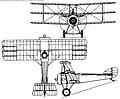 | A three-view drawing (1228 x 1018) |
| CREW | 1 |
| ENGINE | 1 x Clerget, 96kW |
| WEIGHTS |
| Take-off weight | 699 kg | 1541 lb |
| Empty weight | 500 kg | 1102 lb |
| DIMENSIONS |
| Wingspan | 8.1 m | 27 ft 7 in |
| Length | 5.9 m | 19 ft 4 in |
| Height | 3.1 m | 10 ft 2 in |
| Wing area | 24.6 m2 | 264.79 sq ft |
| PERFORMANCE |
| Max. speed | 182 km/h | 113 mph |
| Cruise speed | 170 km/h | 106 mph |
| Ceiling | 6200 m | 20350 ft |
| Range w/max.fuel | 450 km | 280 miles |
| ARMAMENT | 1 x 7.92mm machine-guns |
| BHH, 23.08.2022 17:54 Rest of the world: Oh look! Sopwith copied the Fokker triplane!
Sopwith: *facepalm* reply | | TRIPE, 20.10.2013 00:34 I have to correct Patrick below me. The Sopwith Triplane was well known even in the German military for being the direct attempt by Fokker to imitate the Sopwith and there was never any great secret about it. Although it is true that Fokker had no actual examples of Sop tripes to study up close. This is what led to the structural failures the Fokker tripe was unfortunately known for. reply | | Patrick, 17.08.2013 00:02 In fact, the Fokker Dreidecker Dr.I wasn't a copy of Sopwith project. Basically it was a three wing version of Fokker D.VI. In fact, triplanes were relative common in prototypes before 1916. Anthony Fokker used some captures Tripes as testbeds for the development of Dreidecker during the Great War but he didn't pretend to copy the Sopwith aircraft. reply | | Patrick, 17.08.2013 00:02 In fact, the Fokker Dreidecker Dr.I wasn't a copy of Sopwith project. Basically it was a three wing version of Fokker D.VI. In fact, triplanes were relative common in prototypes before 1916. Anthony Fokker used some captures Tripes as testbeds for the development of Dreidecker during the Great War but he didn't pretend to copy the Sopwith aircraft. reply | |
| | richo, e-mail, 11.10.2012 13:29 The Sopwith Tripe was hicghly succesful as its combat recoerd shows, and it was better than the Fokker D1 and the other German copies.However, the incompetant Gritish supply system of the day, cosidered it to be too difficult to maintain, and like the fantastic Bristol MCI, it was virtually ignored, and only small nombers ordered- to the disgust of the RFC pilots who longed for them reply | | Jim Glover, e-mail, 22.03.2012 01:34 With the successes of the RNAS Tripes up North (Belgium), the Imperial military ordered that any tripes recovered were to be shipped to the Fokker works and copies were to immediately be put in production. Fokker's designer said the aircraft was too complex and Germany had no suitable engines to use. The Fokker Dreidekker was a smaller, uglier and slower aircraft which was developed to meet the German requirement using the available French Le Rhone engines from Swedish production (Basically slipped out the back door from production for the French by the Swedes.) These engines were claimed to be German. reply | | Michael Bitika, e-mail, 23.07.2009 16:34 Sopwith triplane is basicly a sopwith pup with an extra wing and it only had one vickers gun. reply | | george, e-mail, 25.02.2008 21:59 i want to learn about historic develpment, technical data
description, useness of sopwith triplane reply |
|
Do you have any comments?
|
| 
COMPANY
PROFILE
All the World's Rotorcraft
|