|
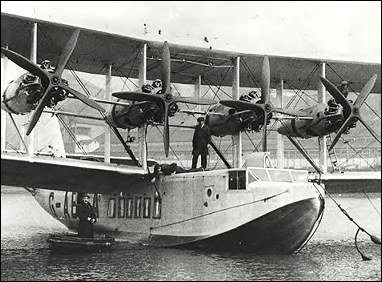
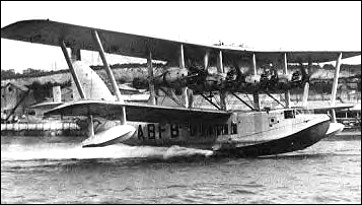
| The closure of Italian and Italian colonial seaports to Imperial Airways in the Mediterranean in 1929 brought a need for a longer range flying boat, with mail carriage a priority. The Kent biplane flying boat was Short's response, and three were built. Imperial Airways also persuaded Short to produce a landplane version of the Kent - the Scylla -which was principally different in
The Scylla landplane version pictured here was rebuilt after a serious accident in 1935 and served early into World War II, when it was damaged beyond economic repair by a storm in 1940.
having a rectangular fuselage and a fixed undercarriage. The two Scylla examples stayed in service longer, and had very short RAF
careers in 1939-40. They were the last of Short's biplane designs and the last in service.
| MODEL | Short S.17 Kent |
| CREW | 2 |
| PASSENGERS | 16 |
| ENGINE | 4 x 555hp Bristol Jupiter XFBM nine-cylinder radial engines |
| WEIGHTS |
| Take-off weight | 14515 kg | 32000 lb |
| DIMENSIONS |
| Wingspan | 34.44 m | 113 ft 0 in |
| Length | 23.90 m | 78 ft 5 in |
| Height | 8.53 m | 28 ft 0 in |
| PERFORMANCE |
| Max. speed | 220 km/h | 137 mph |
| Ceiling | 5335 m | 17500 ft |
| Range | 724 km | 450 miles |
| Barry, 28.06.2016 14:26 The detail above makes absolutely no sense. reply | | Bradley, e-mail, 07.09.2009 19:37 Why were there only 3 s.17 Kents built? reply | | Lester, e-mail, 21.09.2008 21:25 For a great video of this plane in flight, www.youtube.com /watch?v=PmuNQXst6nI&feature=related Thanks for a great site. reply |
|
Do you have any comments?
|
| 
COMPANY
PROFILE
All the World's Rotorcraft
|




Thank
reply